
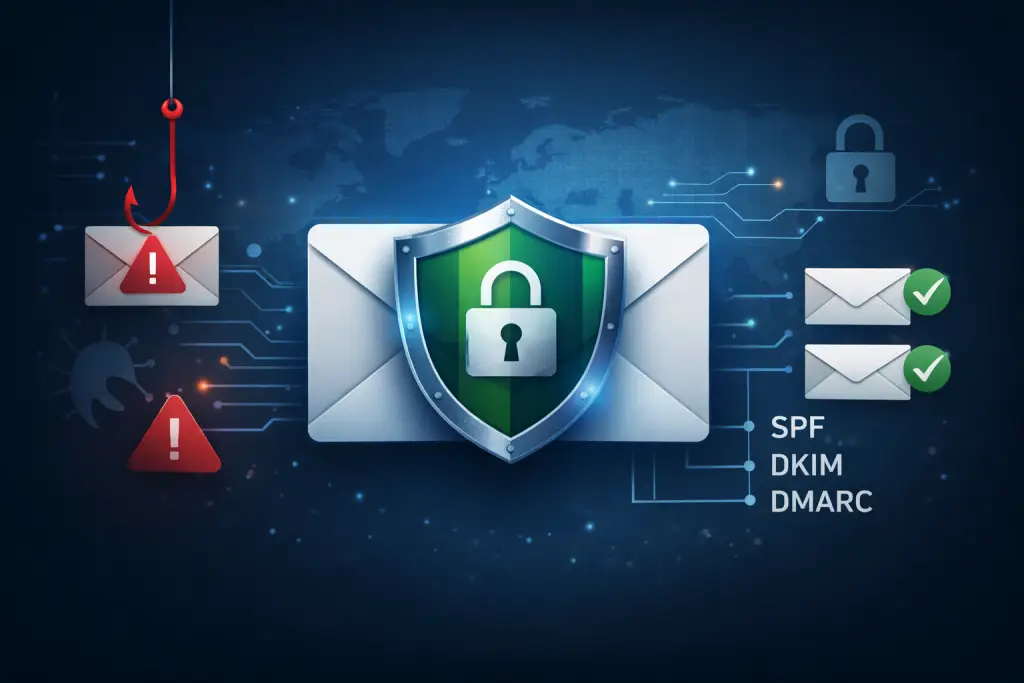
Email remains the most trusted communication channel in business, yet it is also the most commonly exploited. Properly configured email authentication is one of the simplest and most effective ways to reduce phishing and impersonation risk.
Understanding Email Authentication
- SPF specifies which mail servers are allowed to send email on behalf of your domain
- DKIM ensures messages have not been altered in transit
- DMARC ties these controls together and defines how failed authentication should be handled
Why DMARC Matters
DMARC goes beyond basic authentication by adding policy enforcement and reporting. It allows domain owners to instruct receiving mail systems on what to do when authentication fails and provides visibility into all systems attempting to send email using the domain.
Organizations that fully implement DMARC see tangible benefits:
- Reduced phishing and spoofing attempts using their domain
- Improved trust with customers, partners, and vendors
- Better email deliverability and fewer messages routed to spam
- Clear visibility into third party email services
- Stronger protection for employees against impersonation attacks
"The risk is not misconfiguration.
The risk is incomplete enforcement."
The Most Common Oversight
A frequent issue we encounter is incomplete implementation. SPF records are outdated, DKIM is enabled for only one platform, and DMARC is left in monitoring mode indefinitely. Over time, new services are added such as CRMs, marketing platforms, payroll providers, or support tools, but email authentication is never revisited.
Attackers take advantage of this gap.
Without enforcement, fraudulent emails can still appear legitimate to recipients, increasing the likelihood of successful phishing attempts.
A Small Investment With Significant Impact
Proper email authentication does not require new software or complex infrastructure. It requires careful configuration, validation across all email sources, and a clear enforcement strategy.
The payoff is significant. Strong email authentication reduces risk, improves trust, and strengthens the overall security posture of an organization with relatively low ongoing maintenance.
How Franklin Web Technologies Can Help
Email authentication is one of the first areas we assess when helping organizations improve their security posture. A short review often uncovers gaps that can be addressed quickly and with measurable impact.
Franklin Web Technologies helps businesses validate email sources, properly configure SPF, DKIM, and DMARC, and safely move domains to enforcement. Our approach focuses on reducing phishing risk, improving deliverability, and ensuring secure, trusted communication between organizations, employees, and customers.
If you are unsure whether your email authentication is fully enforced or want a second set of eyes, this is one of the highest value security improvements you can make.